Medical Disclaimer: This article is for educational purposes only and does not constitute medical advice. If you have a diagnosed sleep disorder, take prescription medications, or have a psychiatric or neurological condition, please consult a qualified healthcare professional before making major changes to your sleep schedule or taking supplements.
A misaligned sleep schedule is one of the most overlooked, yet highly fixable, drivers of chronic fatigue, mood disturbances, and poor metabolic health. While about 1 in 3 U.S. adults routinely fails to get enough sleep, an even larger percentage sleeps at the wrong time. When your bedtimes and wake times drift out of sync with your body's internal clock, the result is daytime grogginess, poor physiological recovery, and frustrating night-time wakefulness that no amount of coffee can cure.
This guide breaks down the biology of the circadian system and translates it into a highly practical, actionable reset protocol. It builds on the foundational concepts in our Energy and Fatigue Guide and the cellular mechanics detailed in How Metabolism Works, focusing specifically on how to deliberately shift your sleep timing using the strongest natural levers available: light, melatonin, behavior, and environment.
Quick Summary (TL;DR)
- The Master Clock: Your sleep–wake timing is governed by the suprachiasmatic nucleus (SCN) in the brain, which is tuned by zeitgebers (time cues)—primarily light, but also meals, exercise, and temperature.
- The Big Four: The most powerful levers to shift your clock, in order of effectiveness, are bright morning light, a rigidly consistent wake time, dimmed evening environments (no screens), and well-timed, low-dose melatonin.
- The Saboteurs: Caffeine consumed after 2:00 p.m. and alcohol consumed within three hours of bed are the most common ways we sabotage our sleep. Both fragment your sleep architecture and delay your biological clock.
- The Timeline: Most adults can shift their bedtime by 15 to 30 minutes per day, achieving a full 2–3 hour schedule shift within a single week of disciplined environmental changes.
The Science of Circadian Physiology and Chronotypes
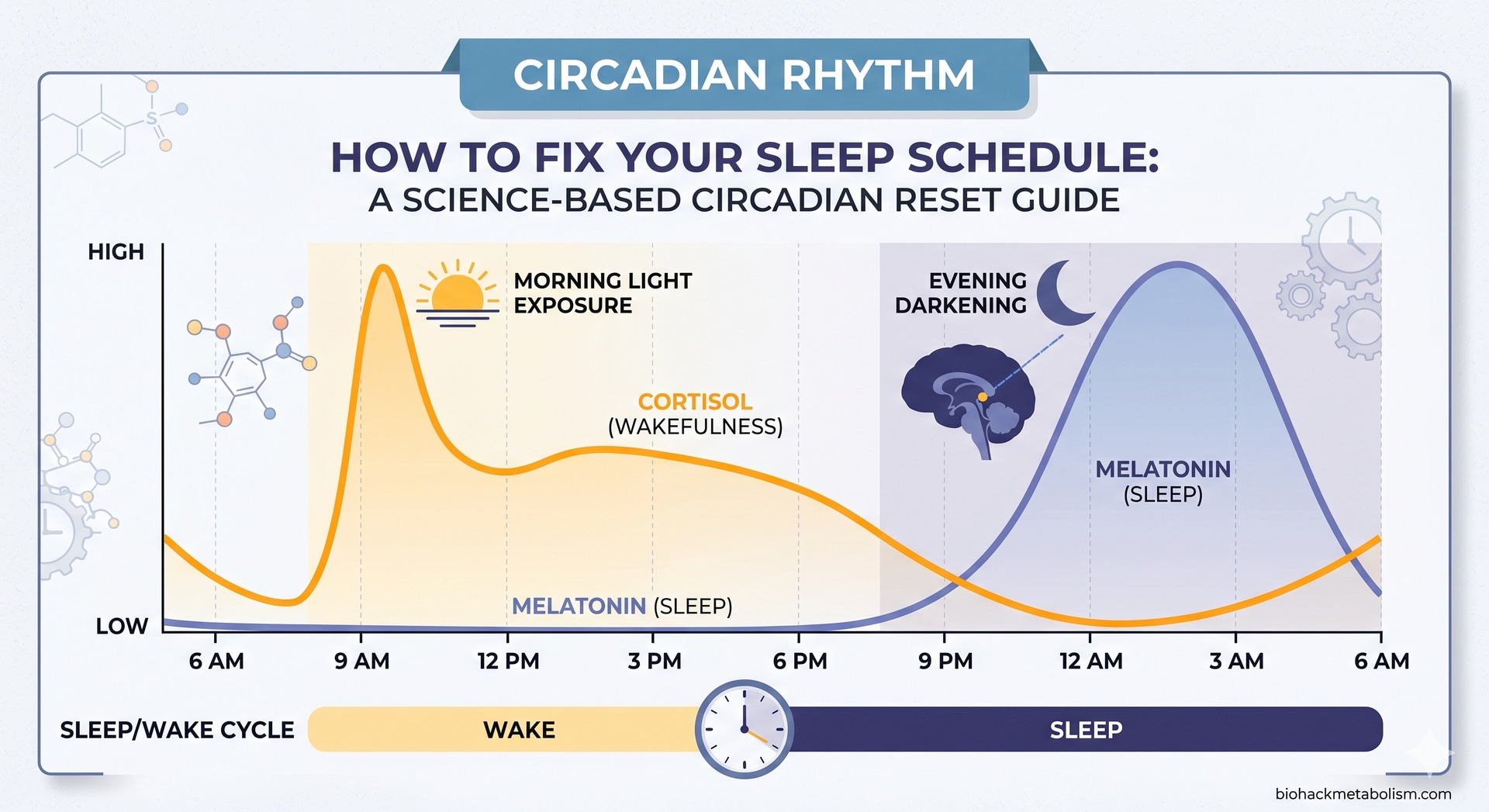
Human sleep–wake timing is fundamentally driven by the suprachiasmatic nucleus (SCN), a tiny cluster of roughly 20,000 neurons located in the hypothalamus. This acts as your brain's central pacemaker. The SCN receives direct light input through specialized intrinsically photosensitive retinal ganglion cells (ipRGCs) in your eyes. It then signals the pineal gland to release the hormone melatonin at night.
As ambient evening light fades, melatonin levels rise, and your core body temperature falls. This coordinated drop is the biological green light that prepares your body for deep sleep. The NIH's comprehensive overview of circadian rhythms highlights how chronic disruption of this elegant system drives insomnia, mood disorders, and widespread metabolic dysfunction.
Understanding Your Chronotype
People naturally differ in their intrinsic chronotype: morning "larks" run early, while night "owls" run late. Your chronotype is heavily influenced by genetics but also shifts with age. Puberty biologically pushes teenagers toward later phases (which is why 6:00 a.m. school alarms conflict with adolescent biology). Conversely, older adults tend to experience a phase-advance—getting sleepy much earlier in the evening and waking before dawn as natural melatonin amplitude declines.

Getting even 10 to 15 minutes of outdoor daylight within an hour of waking advances your circadian phase, helping you fall asleep easier the following night.
Photo by UnsplashTracking Your Rhythm and Identifying Your Baseline
Before attempting a full reset, you must measure your baseline. Keep a manual sleep diary or use a reliable wearable device for one to two weeks. Log your in-bed time, estimated sleep onset, number of awakenings, wake time, and subjective morning energy. Standardized questionnaires like the Morningness–Eveningness Questionnaire (MEQ) can also help you objectively quantify your chronotype.
In clinical settings, specialists measure dim light melatonin onset (DLMO)—the exact time your salivary or blood melatonin begins to rise in a dim environment—to pinpoint the start of your biological night. While DLMO testing isn't necessary for the average person, maintaining a detailed sleep diary combined with strict light management is usually enough to confirm your clock is shifting.
Environmental Cues: Mastering "Zeitgebers"
Your internal clock is blind; it relies entirely on zeitgebers (German for "time givers") to sync with the 24-hour day.
- Light: The undisputed king of zeitgebers. Bright morning light advances the clock (making you sleep/wake earlier), while bright evening light delays it.
- Temperature: Your bedroom temperature interacts with the natural pre-sleep drop in your core body temperature. For optimal sleep, most adults require a room between 16–19 °C (60–67 °F).
- Meals and Movement: These act as secondary cues. Late, heavy dinners shift your rhythm later, while morning exercise reinforces an earlier phase.
Evidence-Based Interventions for a Circadian Reset
1. Strategic Light Therapy
Bright light exposure is the single most potent, non-pharmacological tool for shifting your circadian phase. A standard clinical light box delivers about 10,000 lux of illumination at eye level, approximating outdoor daylight and fully saturating the SCN's response mechanism.
Timing dictates the outcome:
- To advance your clock (sleep/wake earlier): Get bright light immediately after waking, ideally for 20–60 minutes.
- To delay your clock (sleep/wake later): Get bright light in the late afternoon or early evening.
- Limit evening light: When trying to shift earlier, dim your overhead lights, switch to warm low-wattage floor lamps, and strictly avoid screens in the 1–2 hours before bed.
The American Academy of Sleep Medicine (AASM) recommends structured light therapy as a primary, first-line treatment for circadian rhythm sleep–wake disorders.
Practical Setup: Sit 18 to 24 inches away from a 10,000-lux therapy box for 20–30 minutes, keeping your eyes open but not staring directly into the light. You can eat breakfast or read during this time. Alternatively, "dawn-simulator" alarm clocks are fantastic, gentle supplements for advancing your wake time.
Caution: Bright light therapy is generally very safe, but should be used cautiously by individuals with bipolar disorder (as it can occasionally trigger mania) and those with retinal diseases. Always consult a doctor if you have a history of either.

20–60 minutes of 10,000-lux exposure shortly after waking shifts the clock earlier; the same exposure in late afternoon shifts it later.
Photo by Unsplash2. Targeted Melatonin Supplementation
Melatonin is not a sedative; it is a chronobiotic. It shifts your clock through entirely different biological pathways than light. Small, physiological doses (0.5–3 mg) of exogenous melatonin can predictably advance or delay your rhythm depending on the exact hour you take it.
- For a phase advance (earlier sleep): Take a very low dose (0.5–1 mg) about 1–2 hours before your new target bedtime.
- For a phase delay (later sleep): Counterintuitively, taking melatonin upon waking or in the very early morning delays the clock (useful for night-shift workers).
More is not better. High doses (5mg+) often result in a "spillover" effect, leaving melatonin in your bloodstream upon waking, causing intense grogginess. The NIH Office of Dietary Supplements confirms melatonin is generally safe and well-tolerated for short-term use.
3. Dialing in Caffeine and Alcohol Timing
Caffeine has an average plasma half-life of roughly five hours (though it ranges from 2 to 12 hours depending on genetics). Consuming caffeine close to bedtime delays the natural onset of melatonin and fundamentally ruins your deep sleep architecture. While the FDA caps safe daily intake at around 400 mg, the golden rule for a sleep reset is zero caffeine after 2:00 p.m.
Alcohol is a deceptive sedative. It may help you lose consciousness faster, but it is catastrophic for sleep quality. It severely suppresses REM sleep in the first half of the night and triggers fragmented, micro-awakenings in the second half as it metabolizes. Rule of thumb: Cease all alcohol consumption at least three hours before bed.
4. Aligning Meals and Exercise
Late meals act as a rogue zeitgeber, signaling to your body that the day is still active. Aim to stop eating heavy meals 2–3 hours before your target bedtime.
Exercise is brilliant for sleep, but timing is critical. Vigorous evening workouts spike core temperature and cortisol, making it incredibly hard to wind down. Try to shift high-intensity training to the morning or early afternoon. As noted by the Physical Activity Guidelines for Americans, regular moderate aerobic activity dramatically improves baseline sleep efficiency.

Outdoor exercise within an hour of waking combines bright light, temperature elevation, and metabolic signaling—creating a highly leveraged window for circadian alignment.
Photo by Unsplash5. Advanced Behavioral Strategies (CBT-I Elements)
Cognitive Behavioral Therapy for Insomnia (CBT-I) is the gold-standard, first-line medical treatment for chronic insomnia. Two specific tactics from CBT-I are incredibly useful when resetting your schedule:
- Stimulus Control: If you get into bed and cannot fall asleep within 15–20 minutes, get out of bed. Go to a different room, keep the lights dim, and do something relaxing (like reading a physical book) until your eyelids feel heavy. This prevents your brain from associating your mattress with the frustration of being awake.
- Bed = Sleep Only: Never work, eat, argue, or scroll on your phone in bed. Protect the psychological association between your bed and sleep.
Quick-Start Reset Protocols
Identify your scenario below and adapt the framework to your lifestyle. Be patient—do not try to shift your schedule by more than an hour a day, or you will experience "social jet lag."
Night Owl → Earlier Sleep
- Daily strategy: Move bedtime earlier 15–30 min/day; enforce a strict, consistent wake time.
- Light & melatonin: 30 mins bright morning light upon waking; 0.5–1 mg melatonin 1 hr before target bed.
- Substances: No caffeine past 2:00 PM; no alcohol 3 hrs before bed.
- Expected timeline: 1–2 hr shift in 5–7 days; full reset in 2–3 weeks.
Transitioning to Night Shifts
- Daily strategy: Create a dark, cool "cave" for daytime sleep; keep a consistent schedule on days off.
- Light & melatonin: Bright light during the night shift; wear dark sunglasses on the morning commute home.
- Substances: Cut caffeine 4 hrs before the shift ends; zero alcohol.
- Expected timeline: 2–4 weeks for physiological alignment.
Jet Lag (Eastward Travel)
- Daily strategy: Pre-trip, sleep/wake 1 hr earlier per day. On arrival, adapt to local time immediately.
- Light & melatonin: Heavy morning light at destination; 1 mg melatonin at local bedtime for 3–5 nights.
- Substances: No caffeine past local noon; eat meals on local time.
- Expected timeline: ~1 day of recovery per time zone crossed.
Jet Lag (Westward Travel)
- Daily strategy: Pre-trip, sleep/wake 1 hr later per day. On arrival, push through until local bedtime.
- Light & melatonin: Evening light exposure at destination to delay the clock.
- Substances: Avoid morning caffeine if it disrupts your delayed sleep.
- Expected timeline: Easier than eastward travel; ~1 day per time zone.
The 7-Day Night Owl Protocol at a Glance
Core Schedule (every day, including weekends)
- Move bedtime 15–30 minutes earlier each night until you reach your target.
- Hold a strict, consistent wake time — the same hour every single day.
Light & Environment (every day)
- 30 minutes of bright outdoor light within an hour of waking.
- Dim overhead lights and put screens away after 8:00 PM.
- Keep the bedroom cool, dark, and quiet (16–19 °C / 60–67 °F).
Biochemistry
- 0.5–1 mg melatonin ~1 hour before your target bedtime — Days 1–5 only.
- Zero caffeine after 2:00 PM — every day.
Special Populations and Cautions
- Adolescents: Teenagers undergo a biological phase-delay. A 15-year-old naturally falling asleep at 11:30 p.m. is expressing normal human physiology, not laziness. Enforce a consistent wake time, maximize morning sun, and limit late-night screen time.
- Older Adults: Aging often brings an advanced phase (waking at 4:00 a.m.). To delay the clock, seek evening light exposure and consider consulting a doctor about specialized timing for chronobiotics.
- Pregnancy: The half-life of caffeine doubles during pregnancy. The American College of Obstetricians and Gynecologists (ACOG) guidelines suggest keeping daily caffeine under 200 mg. Always consult an OB/GYN before using melatonin.
- Medication Interactions: SSRIs, beta-blockers, corticosteroids, and stimulants can severely alter sleep architecture. Never change medication timing without physician approval.
Putting It All Together: The Ultimate 14-Day Reset Plan
If you want a definitive, step-by-step system, commit to this 14-day protocol:
- Set an Iron-Clad Wake Time: Pick a wake time and stick to it within a 20-minute window every single day, including weekends. Consistency here is non-negotiable.
- Hunt the Morning Sun: Get 15–30 minutes of outdoor daylight within 30 minutes of waking. (Yes, overcast days still provide enough lux).
- Micro-Shift Your Bedtime: Move your target sleep time earlier by just 15 to 30 minutes each night.
- Implement the 2-3-4 Rule: No caffeine 10 hours before bed, no alcohol 3 hours before bed, no heavy meals 2 hours before bed.
- Simulate Dusk: Dim all overhead lights and switch your devices to night mode 90 minutes before your target sleep time.
- Strategic Supplementation (Optional): Use 0.5–1 mg of fast-acting melatonin 60 minutes before your target bedtime for the first 5 to 7 days to chemical trigger the shift.
- Log the Data: Write down your bedtime, wake time, and a subjective 1-10 energy score each morning.
Most individuals will feel a profound, structural shift in their daytime energy by Day 7. If you are still struggling by Day 14, audit your weekend wake times and afternoon caffeine habits—these are the most common points of failure.
For more in-depth insights into how sleep alignment transforms your daily performance and metabolic health, explore our guides on Boosting Energy & Beating Fatigue and Understanding Metabolic Health.
Key References & Further Reading
- Centers for Disease Control and Prevention (CDC). About Sleep. cdc.gov
- National Institute of General Medical Sciences. Circadian Rhythms Fact Sheet. nigms.nih.gov
- NIH Office of Dietary Supplements. Melatonin for Health Professionals. ods.od.nih.gov
- American Academy of Sleep Medicine. Clinical Practice Guidelines. aasm.org
- National Center for Biotechnology Information. Cognitive Behavioral Therapy for Insomnia (CBT-I). ncbi.nlm.nih.gov/books/NBK547927/
- U.S. Food and Drug Administration (FDA). Spilling the Beans: How Much Caffeine is Too Much? fda.gov
- Department of Health and Human Services. Physical Activity Guidelines for Americans. health.gov
- American College of Obstetricians and Gynecologists (ACOG). Moderate Caffeine Consumption During Pregnancy. acog.org