Medical disclaimer: This article is for educational purposes only and does not constitute medical advice. If you have a medical condition or take medication, consult a qualified healthcare professional.
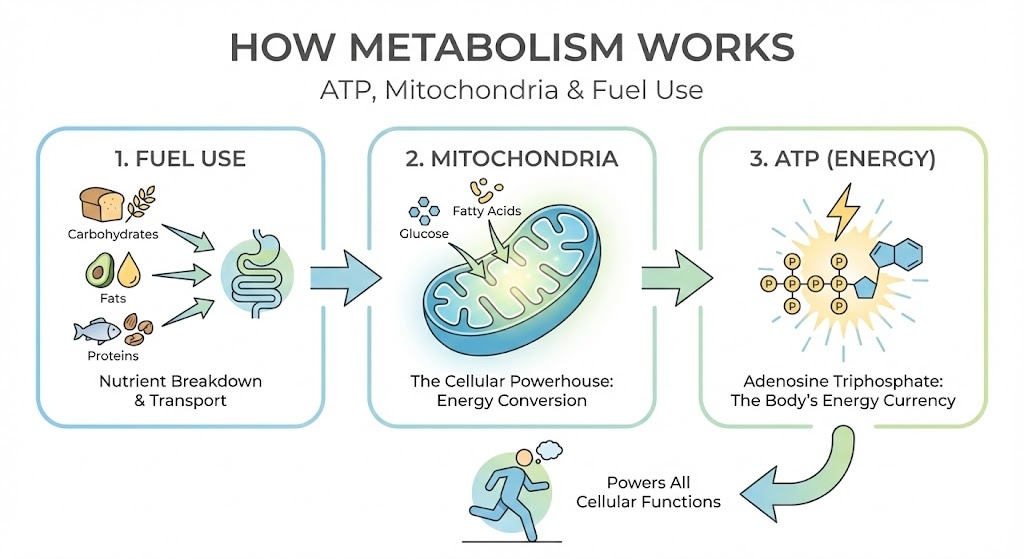
Metabolism isn't a "speed" you're born with—it's the set of processes your body uses to turn food into usable energy and building material, and to store or release fuel depending on what you're doing and whether you've eaten recently. If you're new to this topic, our guide to metabolic health covers the broader picture — biomarkers, weight regulation, blood sugar, and daily energy.
Here, we're going inside the cell: what actually happens when you "burn calories," why mitochondria matter so much, and how your body switches between carbs and fat for fuel.
Quick Summary (TL;DR):
- "Metabolism" includes both breaking down nutrients for energy (catabolism) and building/storing molecules (anabolism).
- Your cells run on ATP, a molecule that powers muscle contraction, nerve signaling, and countless cellular reactions.
- Most ATP is made through a linked chain: glycolysis → citric acid cycle → electron transport chain (oxidative phosphorylation).
- Fuel choice is dynamic: after you eat, the body tends to prioritize glucose use; between meals, fat use rises. That switching ability is a core idea behind metabolic flexibility.
Metabolism Is Not One Number
Metabolism isn't just a rate or a number — it's a set of interlinked processes that together determine how your body uses and allocates energy.
When people say "I have a slow metabolism," they usually mean one of three different things:
Cellular energy production (ATP): how cells convert nutrients into ATP to do work.
Energy expenditure:
- resting metabolism
- food processing (thermic effect)
- physical activity and daily movement
Fuel selection:
- whether your body is mostly burning carbohydrates vs fats right now
- how well it can switch between the two
Scientifically, metabolism refers to the full set of physical and chemical processes that maintain life, including catabolism (breaking down nutrients to generate energy) and anabolism (using energy to build more complex molecules). The IUPAC Gold Book offers a formal definition.
ATP: Your Cells' Spendable Energy
ATP (adenosine triphosphate) is often described as the cell's "energy currency" because it's the molecule cells use to directly power energy-requiring work—like muscle contraction, nerve firing, cell signaling, and building DNA/RNA.
Your body does not store large ATP reserves. It's constantly making and using ATP, which is why understanding ATP production explains many "metabolism" questions (energy, fatigue, exercise tolerance, and fuel switching).
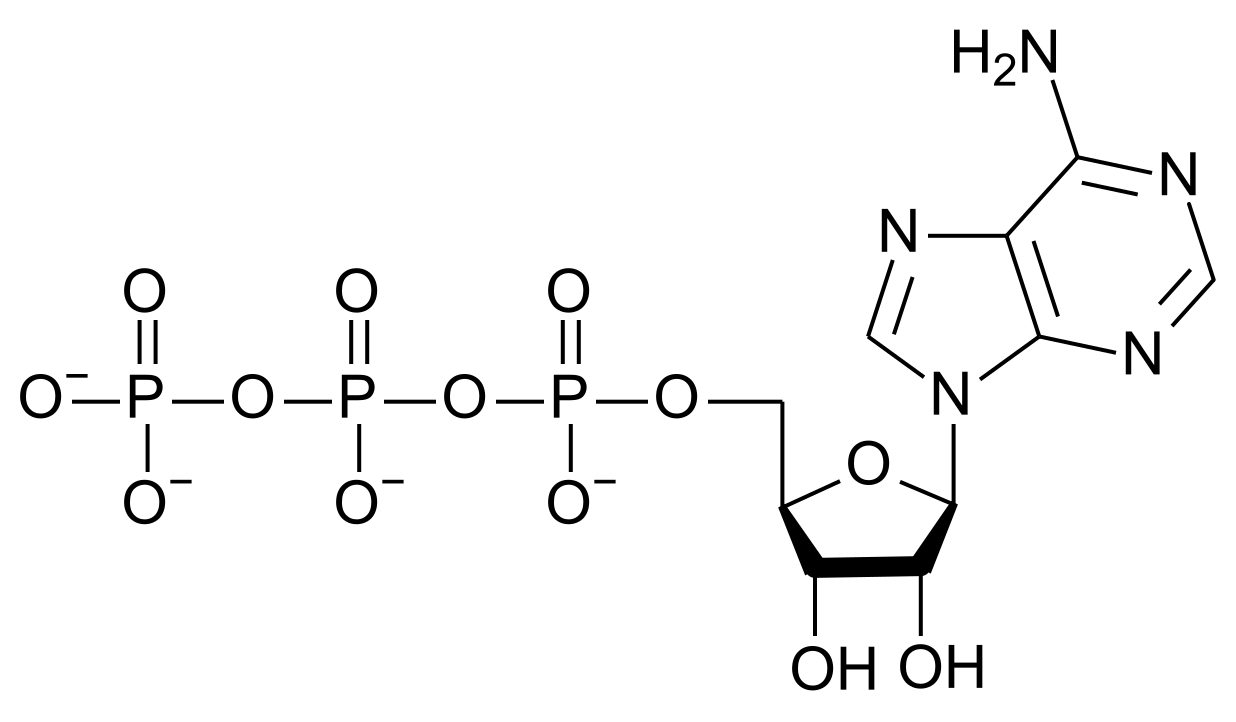
Metabolism is largely about making, using, and regenerating ATP.
Image credit: Wikimedia Commons, public domain.The Three Main Steps of ATP Production
Your cells can generate ATP through multiple routes, but the most common high-yield pathway is cellular respiration, where nutrients (often glucose) are processed and—when oxygen is available—most ATP is produced via mitochondrial oxidative phosphorylation.
Step One: Glycolysis (in the Cytosol)
Glycolysis is the first stage of glucose breakdown, and it takes place in the cell cytosol (not inside mitochondria).
At a high level, glycolysis converts one glucose molecule into two smaller molecules (pyruvate), capturing a small amount of energy along the way.
Glycolysis can proceed without oxygen (it's anaerobic), which is one reason short, intense efforts can be powered quickly — but not efficiently for long durations.
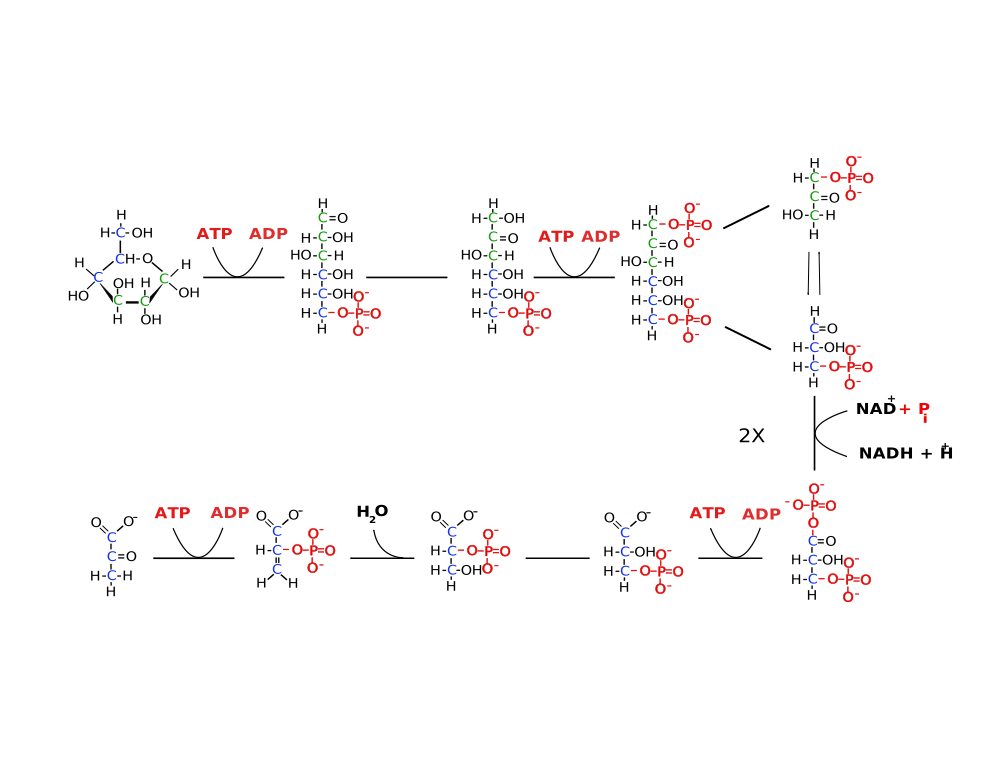
It happens in the cytosol, producing pyruvate and small amounts of ATP/NADH.
Image credit: Rozzychan / Wikimedia Commons (CC0 1.0).Step Two: Citric Acid Cycle (in Mitochondria)
When oxygen is available, pyruvate can be transported into mitochondria and processed into acetyl-CoA, which feeds into the citric acid cycle (also called the Krebs/TCA cycle). In eukaryotic cells, this takes place in the mitochondrial matrix.
The citric acid cycle is a "hub" pathway: it produces high-energy electron carriers (like NADH and FADH₂) that later drive large-scale ATP production. It also links carbohydrate metabolism with fat and protein metabolism via shared intermediates.

It generates electron carriers (NADH, FADH₂) used to make most ATP.
Image credit: Krishnabp / Wikimedia Commons (CC BY-SA 4.0).Step Three: Electron Transport Chain + Oxidative Phosphorylation (in the Inner Mitochondrial Membrane)
Most ATP from aerobic metabolism is produced through oxidative phosphorylation, where electrons flow through the mitochondrial electron transport chain (ETC), helping generate a proton gradient that powers ATP synthase to produce ATP.
Mitochondria do more than make ATP. ETC activity is also tightly linked to reactive oxygen species (ROS) production and cellular signaling, and mitochondrial dysfunction can drive disease processes in different ways depending on the tissue.
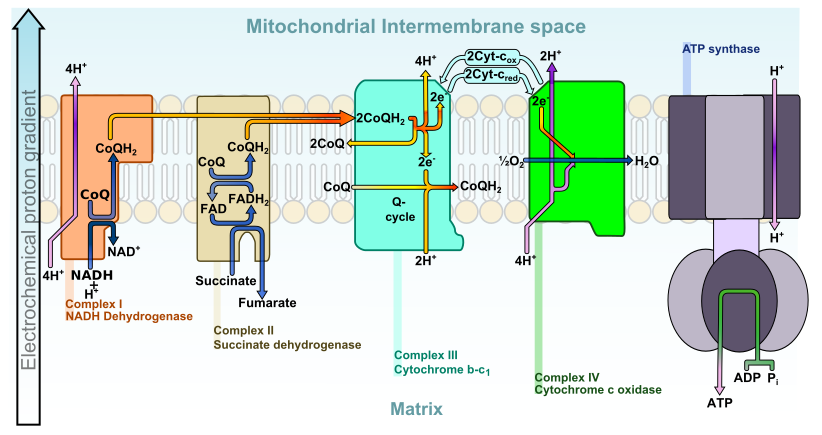
This generates a proton gradient that powers ATP synthase—where most ATP is produced in aerobic metabolism.
Image credit: T-Fork / Wikimedia Commons (CC0 1.0).Fuel Switching: Carbs vs Fat, and What Hormones Do
Your body is constantly balancing fuels:
- After meals: glucose availability rises, and the body generally increases glucose oxidation and storage (e.g., glycogen), while fat oxidation is relatively suppressed.
- Between meals / fasting: exogenous glucose drops, fat mobilization increases, and fat oxidation rises—especially if insulin is low and counter-regulatory signals are higher.
Hormones coordinate this fuel handoff:
Insulin is a central anabolic signal, strongly tied to nutrient storage and glucose homeostasis. When insulin is elevated after a meal, the body prioritizes glucose use and suppresses fat breakdown.
Glucagon counteracts insulin and helps maintain glucose availability by stimulating the liver to release stored glucose. It also supports fat mobilization and ketone production when nutrient supply is limited.
This hormonal coordination is why metabolic health problems rarely appear in isolation: when fuel switching becomes dysregulated, weight regulation, blood sugar stability, and daily energy tend to shift together. That relationship is explored further in our guide to metabolic health.
Where "Calories Out" Actually Comes From
Your "metabolic rate" isn't one thing — it's the sum of several components that make up total daily energy expenditure (TDEE):
- Resting energy expenditure (REE/RMR): generally the largest component, often described as ~60–70% of daily expenditure, and typically ~10% higher than true basal metabolic rate (BMR).
- Thermic effect of food (TEF/DIT): the energy cost of digesting, absorbing, metabolizing, and storing nutrients; often described around ~10% (though it varies by diet composition).
- Physical activity energy expenditure (PAEE): includes exercise and non-exercise activity thermogenesis (NEAT), and is typically the most variable component across people.
Knowing these components reframes "metabolism" away from one fixed number. Movement patterns, body composition, and eating habits all shift the balance — and those are things you can actually change.
Metabolic Flexibility: An Evidence-Based Explanation
Metabolic flexibility is the capacity to switch among energy substrates (primarily carbs and fats) to generate ATP depending on circumstances (fasting vs feeding, rest vs exercise).
A classic way researchers estimate fuel selection is via respiratory quotient (RQ) / respiratory exchange ratio (RER)—the ratio of carbon dioxide produced to oxygen consumed. Roughly speaking:
- RQ closer to 1.0 indicates greater carbohydrate oxidation
- RQ closer to 0.7 indicates greater fat oxidation
Metabolic flexibility matters because it directly connects to several areas of metabolic health:
- Energy production: fuel selection + ATP production capacity
- Weight regulation: energy balance and the ability to access stored fat for fuel
- Blood sugar: insulin sensitivity + stable glucose handling
- Daily energy: efficient mitochondria + fewer energy crashes
In other words, how well your body switches fuels affects nearly every metabolic outcome you care about — from body composition to blood work to how you feel hour-to-hour.
Why This Matters for Metabolic Health
Everything above — ATP production, fuel switching, hormonal coordination — might feel like textbook biology. But these mechanisms are the reason metabolic problems rarely show up in isolation. When one part of this system falters, the others tend to follow.
Poor mitochondrial function means your cells can't produce enough ATP to meet demand. The result is chronic fatigue, brain fog, and reduced exercise tolerance — even when you're sleeping and eating "enough." Over time, underperforming mitochondria also impair how efficiently your body burns fat, setting the stage for weight gain.
Poor fuel switching (metabolic inflexibility) means your body stays locked into burning one fuel source — usually glucose — and can't ramp up fat oxidation between meals or during lower-intensity activity. That's why some people feel shaky, irritable, or drained if they miss a meal, and why stored body fat stays stubbornly in place despite calorie restriction.
Hormonal dysregulation — particularly chronic high insulin — ties the other two together. When insulin stays elevated, fat burning is suppressed, glucose floods cells that can't use it efficiently, and the pancreas works overtime. The downstream effects are the ones most people notice first: energy crashes after meals, expanding waistlines, and blood sugar readings that creep upward year after year.
These three threads — mitochondria, fuel switching, and hormones — are the cellular machinery behind the symptoms most people notice first. Our guide to metabolic health walks through how these mechanisms translate into real-world outcomes: weight regulation, blood sugar control, and daily energy levels.
Understanding the "how" gives you a clearer picture of why the standard advice — exercise, whole foods, sleep, stress management — actually works. These aren't generic wellness tips; they're direct interventions on the pathways described in this article.
References:
- IUPAC Gold Book. Definition of "metabolism." goldbook.iupac.org.
- OpenStax. Energy and Metabolism: Catabolism + Anabolism. openstax.org.
- NIGMS. Science Snippet: ATP's Amazing Power. nigms.nih.gov.
- OpenStax. Glycolysis. openstax.org.
- OpenStax. Citric Acid Cycle and Oxidative Phosphorylation. openstax.org.
- Review: Mitochondrial ETC and Oxidative Phosphorylation. pmc.ncbi.nlm.nih.gov.
- National Academies. Components of Daily Energy Expenditure. nationalacademies.org.
- Metabolic Flexibility: Definition and Measurement Context. pmc.ncbi.nlm.nih.gov.