Medical disclaimer: This article is for educational purposes only and does not constitute medical advice. If fatigue is persistent, severe, or interferes with daily life, consult a qualified healthcare professional.
Persistent low energy is one of the most common reasons adults visit primary care — and one of the most fixable when the underlying drivers are addressed methodically. About 1 in 3 U.S. adults routinely fails to get the recommended amount of sleep. Chronic short sleep alone reshapes hormones, glucose handling, and alertness in ways that show up as midday slumps and stubborn afternoon fatigue.
This guide turns the science of energy production into practical levers you can pull this week. It builds on the foundations covered in our metabolic health guide and the cell-level mechanics in How Metabolism Works: ATP, Mitochondria, and Fuel Switching, shifting the focus to the day-to-day lifestyle decisions that directly influence your vitality.
Quick Summary (TL;DR):
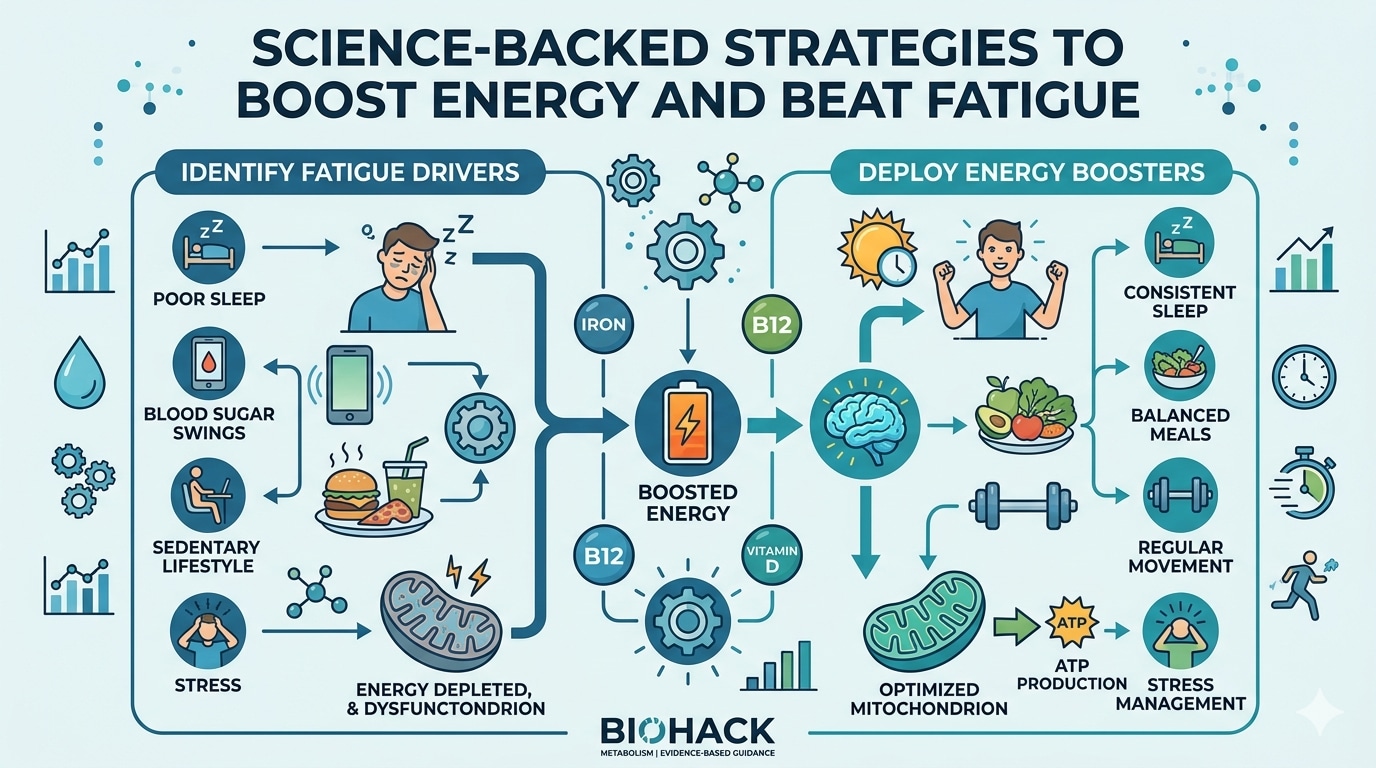
- Energy is produced by mitochondria, but felt through sleep quality, blood sugar stability, hydration, hormones, and stress levels.
- The most reliable levers for high energy are consistent sleep timing, morning daylight exposure, regular movement, and balanced meals eaten earlier in the day.
- Supplements help mostly when correcting a specific deficiency. Caffeine works temporarily, but it's a borrowed tool, not free energy.
- Track your patterns. If fatigue persists despite mastering the basics, screen for iron, B12, vitamin D, thyroid function, and sleep apnea.
How Energy Is Produced — and Why You Still Feel Tired
Every cell in your body runs on ATP (adenosine triphosphate), generated mainly inside your mitochondria from carbohydrates and fats (with oxygen). When your mitochondria are healthy and fuel is available, the ATP supply meets your body's demand, resulting in feelings of alertness and focus. However, when any link in this chain breaks — due to poor sleep, wild blood sugar fluctuations, low iron, or chronic stress — perceived energy drops sharply, even if your cells are technically capable of producing ATP.
In other words, "low energy" is rarely a single, isolated problem. It is usually the result of several lifestyle inputs nudging your biological systems off-course.

Combining protein, fiber, and healthy fats helps stabilize blood sugar and maintain consistent energy throughout the day.
Image source: Unsplash — balanced nutrition plate.Optimize Sleep and Align Your Circadian Rhythm
Sleep is not a "nice to have" for daily energy; it is the physiological substrate that energy is built upon. Most adults require 7–9 hours per night, yet the CDC notes that a vast portion of the population regularly falls short. Chronic sleep deprivation raises ghrelin (the hunger hormone) and cortisol (the stress hormone), blunts insulin sensitivity, and dramatically increases next-day fatigue.
But sleep duration is only half the story. Timing matters just as much. Your circadian clock — a network of body-wide oscillators governed by a master clock in the brain — drives daily rhythms in alertness, body temperature, hormones, and even your overall metabolic rate. Research on circadian rhythms shows that when your sleep–wake schedule drifts, every downstream system drifts with it.

Even light activity boosts alertness immediately, while regular training improves mitochondrial function and endurance.
Image source: Unsplash — outdoor running fitness.Actionable Sleep Strategies:
- Anchor your wake time, not just your bedtime: A consistent rise time is the most powerful signal you can give your body clock. Waking up within a 30-minute window daily — even on weekends — sharpens alertness across the entire day.
- Get bright light within an hour of waking: Even 10 minutes of outdoor daylight (overcast skies count) advances your circadian phase and drastically improves evening sleep onset.
- Front-load light, dim the evening: In the last 1–2 hours before bed, dim screens and overhead lights. Bright evening light suppresses melatonin production and pushes sleep onset later.
- Optimize the bedroom environment: Keep it cool, dark, and quiet. Most people sleep best around 16–19 °C (60–67 °F).
- Screen for sleep apnea: If you snore loudly, gasp for air, or wake unrefreshed despite adequate sleep time, consult a doctor. It is a common and treatable root cause of chronic exhaustion.
Fuel Your Cells: Nutrition, Hydration, and Meal Timing
What you eat — and exactly when you eat it — dictates the shape of your daily energy curve.
Build Meals That Don't Spike-Then-Crash
Refined carbohydrates alone produce sharp glucose rises followed by reactive drops, and those drops manifest physically as fatigue, brain fog, and irritability. Pairing carbs with protein, fiber, and healthy fats flattens this curve.
Practical dietary defaults for sustained energy:
- Prioritize dense protein: Include a strong protein source at every meal (e.g., egg whites, Greek yogurt, fish, lean meats, or tofu).
- Choose high-fiber carbs: Use vegetables, legumes, and intact whole grains like couscous as your carbohydrate base.
- Mind your portions with dense carbs: If you enjoy regional breads, like a traditional Armenian lavash, track your portions to manage caloric intake and pair it with a healthy fat or protein to slow digestion and blunt a potential glucose spike.
- Take a post-meal walk: A 10–15 minute walk after larger meals is one of the fastest, most effective ways to stabilize a blood glucose spike.

Practices like slow breathing and mindfulness reduce cortisol and improve recovery between stress cycles.
Image source: Unsplash — meditation and mindfulness.Eat Earlier in the Day
Your circadian clock also controls insulin sensitivity and gastric emptying. Clinical reviews on intermittent fasting and chrononutrition suggest that concentrating your caloric intake during daylight hours improves both glucose handling and overnight sleep quality. A simple rule is to finish your last meal at least 2–3 hours before bed.
Don't Underrate Hydration
Even mild dehydration (~1–2% of body weight) measurably impairs cognitive performance, mood, and perceived energy. Keep water accessible and drink consistently throughout the day rather than chugging water in the evening, which will only wake you up at night.
Move Your Body: Exercise for Mitochondrial Power
Exercise is arguably the most reliably "energizing" intervention available. Acutely, even a short bout of light-to-moderate activity raises alertness more than a small dose of caffeine. Chronically, regular movement triggers mitochondrial biogenesis — meaning your muscles literally build more mitochondria, permanently raising your baseline capacity to produce energy.
A practical weekly target based on the Physical Activity Guidelines for Americans:
- 150 minutes of moderate aerobic activity (or 75 minutes of vigorous activity).
- 2 sessions of resistance training to preserve and build muscle tissue.
- A daily floor of movement: Break up sedentary time with walking, taking the stairs, or doing micro-breaks every hour.
Key Nutrients and Evidence-Based Supplements
Most over-the-counter "energy supplements" are either unproven or simply rely on high doses of caffeine. The main exception is correcting an actual nutritional deficiency.
- Iron: Carries oxygen to the muscles and brain. Deficiency is a leading cause of fatigue. The NIH Office of Dietary Supplements notes fatigue and reduced exercise capacity as classic symptoms. Always test your ferritin levels before supplementing.
- Vitamin B12: Required for red blood cell production and neurological function. B12 deficiency causes profound fatigue and weakness.
- Vitamin D: Low vitamin D is heavily associated with fatigue and muscle weakness. Supplementation in deficient individuals often yields rapid symptom improvement.
- Magnesium: A vital cofactor for hundreds of enzymatic reactions, including ATP production.
- Caffeine: Reliably improves alertness. The FDA recommends capping intake at ~400 mg/day. Avoid it within 8–10 hours of bedtime.
- Niche Supplements (CoQ10, NAD+, Adaptogens): Evidence remains preliminary. The UK's NICE guideline on ME/CFS explicitly cautions against attempting to treat chronic fatigue with unproven supplements. Fix your foundation first.
Manage Stress and Hormones
Chronic stress floods the body with cortisol, disrupts deep sleep, dysregulates appetite, and over time can blunt thyroid hormone conversion. The goal isn't to eliminate stress completely, but to build in shorter recovery windows between stressors.
- Slow breathing: Taking 5–6 breaths per minute for 5 minutes lowers acute stress markers and raises heart rate variability (HRV).
- Outdoor walks: Combines circadian alignment, cardiovascular health, and stress recovery.
- Brief mindfulness: 10 minutes a day improves perceived stress and sleep in randomized trials.
If fatigue persists alongside cold intolerance, unexplained weight changes, or depression, ask your clinician about thyroid function (TSH, free T4) and depression screening. The Mayo Clinic lists these among the leading drivers of unexplained tiredness.
Track Energy and Troubleshoot Persistent Fatigue
You can't fix what you don't measure. Try a two-week energy audit to surface patterns that are invisible day-to-day. Log your bed/wake times, caffeine intake, meal composition, and energy ratings at three daily checkpoints (morning, afternoon, evening).
When to escalate to a clinician:
- Fatigue lasting more than a few weeks despite lifestyle improvements.
- Unexplained weight loss or gain, persistent breathlessness, or chest pain.
- Loud snoring or waking unrefreshed despite long sleep.
A reasonable first-pass medical workup includes CBC, ferritin, TSH, vitamin B12, vitamin D, and HbA1c. Persistent post-exertional malaise lasting more than three months warrants evaluation against the NICE ME/CFS criteria.
Putting It Together: A Two-Week Reset
If you want a clear starting protocol, run this for 14 days:
- Anchor a consistent wake time (within 30 minutes daily) and get 10+ minutes of outdoor light immediately.
- Build every meal around protein + fiber + healthy fats to prevent crashes. Stop eating 3 hours before bed.
- Hit 7,000–10,000 daily steps and do 2 short strength sessions per week.
- Cap caffeine at ~400 mg/day, stopping by 2 p.m. Minimize alcohol.
- Add a 5-minute slow-breathing block once a day.
- Log your energy at three daily checkpoints to track progress.
Most people notice a clear shift in 2–3 weeks. For more on the underlying biology that makes these levers work, see our guides on metabolic health and how metabolism works.
References:
- Centers for Disease Control and Prevention. About Sleep. cdc.gov.
- National Institute of General Medical Sciences. Circadian Rhythms — Fact Sheet. nigms.nih.gov.
- Harvard Health Publishing. 9 tips to boost your energy — naturally. health.harvard.edu.
- Johns Hopkins Medicine. Intermittent Fasting: What is it, and how does it work? hopkinsmedicine.org.
- U.S. Department of Health and Human Services. Physical Activity Guidelines for Americans, 2nd Edition. health.gov.
- NIH Office of Dietary Supplements. Iron — Health Professional Fact Sheet. ods.od.nih.gov.
- NIH Office of Dietary Supplements. Vitamin B12 — Consumer Fact Sheet. ods.od.nih.gov.
- U.S. Food and Drug Administration. Spilling the Beans: How Much Caffeine is Too Much? fda.gov.
- National Institute for Health and Care Excellence (NICE). Myalgic encephalomyelitis (or encephalopathy)/chronic fatigue syndrome: diagnosis and management (NG206). nice.org.uk.
- Mayo Clinic. Fatigue — Causes. mayoclinic.org.